Intro To Indy - Andretti Global - Pt 2- Marcus Ericsson

Unlike the past few teams, I'm going to work my way backwards through the Andretti Global team. Maybe because Ericsson is the oldest, maybe because he has the most story behind him, maybe because it's fun to change the strategy.
First on my roster, in his second year with Andretti, is Marcus Ericcson. Here is his headshot from his driver profile on the Indycar website.
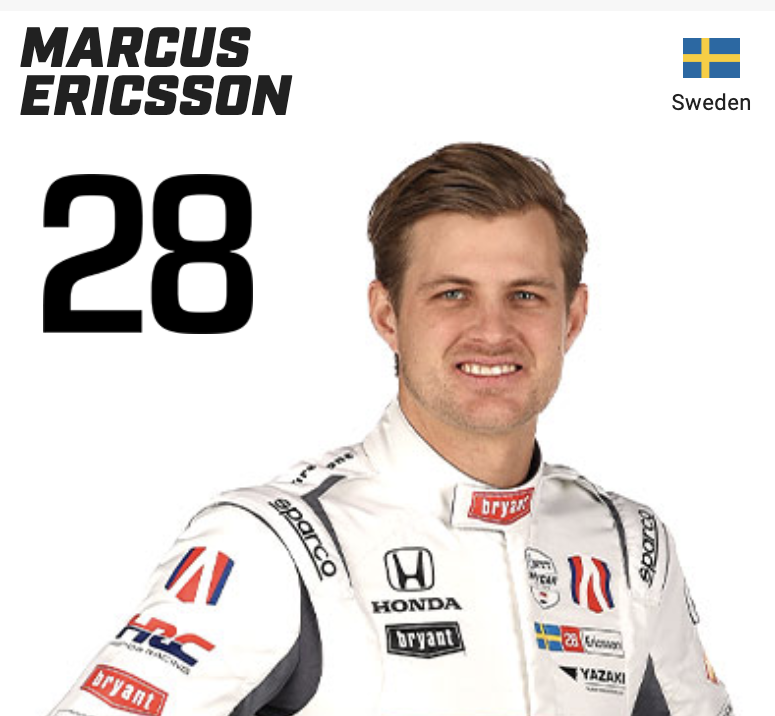
Though Marcus is the newest addition to the roster (Kirkwood only gets a foot up because he was an IndyNXT Andretti driver), he is the most experienced of the bunch.
Born in Sweden in 1990, he began karting in 1999 at nine years old. Not coming from a racing family, or a family with much money, karting was fun but he never thought he'd make it to Formula level.
He karted for four years, winning Formula Mini Sweden in 2003. He stepped into the ICA Junior category in 2004.
Then, in 2006, a CART champion and Indy 500 winner Kenny Bräck spotted him in a race and decided to back him.
2007 saw Marcus elevated to Formula BMW (which no longer operates) where he won as a rookie. After that, he followed the traditional path to F3 in 2008 and 2009. Similarly to current champion Palou, he found much more success in the Asian market than the European market. He came first in his rookie season of All-Japan Formula 3.
2009 also had him test drive a Formula 1 car for the first time for Brawn GP. Brawn now operates as Mercedes.
After that, he progressed to GP2 - which has now consolidated into F2 - from 2010-2013 and slowly progressed up the standings.
Though he never won GP2, his consistency along with other factors had him jump up to Formula 1 in 2014.
Starting with Caterham in his rookie year, he drove for sixteen out of the nineteen races before the team went into administration (for those who speak American English, they folded and were unable to complete the season due to financial reasons). But Sauber took him on, and he was with the team from 2015-2018. His highest placement was eighth in the points, and 17th in the championship.
Then, in 2019, he transitioned over to IndyCar. Seeing at the person who discovered him and supported him in the beginning came from the now defunct CART series in the US, it isn't too much of a surprise.
IndyCar is not a subpar series for those who don't make it to Formula 1 to land. It's its own style of driving, style of car, style of almost everything. It also has drivers from all different backgrounds, and doesn't limit itself to the feeder series like IndyNXT for talent. It also isn't a place where people who aren't well funded or well connected rest on their laurels.
So Marcus staying in IndyCar for five years is indicative of a strong driver.
His debut year was with Arrow Schmidt Peterson Racing (now operating as Arrow McLaren) in the number 7 car. He missed one race, as he was still a standby for Sauber under the Alfa Romeo branding and had been called in, but returned for the season finale.
In 2020, he transferred to CGR in the number 8 car, with teammates Dixon and Rosenqvist. In an abbreviated season, he went from seventeenth to a twelfth place finish in the championship, his style aligning more with the CGR car.
2021 proved to be more fruitful. In the sixteen races, he won twice, had an additional podium, and only came outside of the top ten four times, putting him in sixth position in the championship.
Then came 2022. Marcus did what no one else at Andretti Global currently has done.
He won the 500.
He came in sixth in the standings that year behind his teammate Palou.
2023, it slipped away from him in the final laps, passed by Josef Newgarden. For a third time, Ericsson finished sixth in the championship.
In 2024, he switched to Andretti Global and the 28 car.
Last year wasn't his strongest, but there were a lot of factors behind that. Any team change normally comes with an adjustment period, along with the adjustment to the hybrid engines. While Andretti had success with Herta, Kirkwood also struggled a lit bit at the back half as well.
Overall, into 2025 we have a consistent lineup of Ericsson, Kirkwood and Herta. Marcus is another strong driver with a good head on his shoulders and his sights set on the title. IndyCar lends a lot of credence to a more mature and stable driver, which he is. He's also very grateful for the opportunity, a thread that I think makes a solid driver.
To choose Ericsson is to choose a calm, consistent path. Great for tuning in on the race weekends, watching him do his thing, and not have to worry about clips of him going viral for any reason besides a great drive over the weekend.
Next up is Kyle Kirkwood.